Live translation

Live translation for events

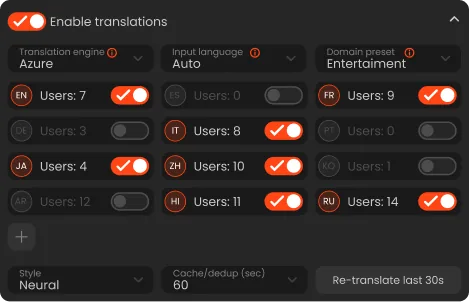
Live event translation converts the source-language caption stream into one or more configured target languages while the event is running. 4ALL LIVE lets producers enable translation, select target languages, tune domain guidance and glossaries, and make available languages accessible in the attendee viewer or selected production outputs. Translation quality should be preflighted with actual program terminology.

Start for free

Last updated

4ALL LIVE translation language configuration

What it is

A production workflow, not a one-size-fits-all promise.

Translation is part of a larger signal path: source audio must first produce usable captions, then the translated result must reach the intended viewer or output. Producers can prepare protected terms and glossary guidance, choose supported translation settings, and monitor the result. Spoken output is an additional workflow and should not be assumed from translated text alone.

Best for

  • International conferences and multilingual panels
  • Festivals and screenings with audiences using different languages
  • Hybrid events that need personal language selection in a browser
  • Productions combining translated text with optional spoken-language access

Plan around

  • Translation quality depends on source captions, context, terminology, language pair, and configuration.
  • Available providers, models, languages, usage, and funding depend on the configured workspace and plan.
  • Translated text does not automatically become spoken audio; standard spoken captions and LL-TTS are separate options.

Capabilities and outputs

What the workflow actually delivers

The exact configuration depends on the event, audience destination, enabled features, and downstream production equipment.

Capabilities for Live translation for events
CapabilityWhat it means in production
Target languagesEnable translation and add the languages that should be available for the event.
Terminology guidanceUse glossary and do-not-translate controls for names, brands, and event-specific language.
Viewer choiceLet attendees choose among the languages made available in the event viewer.
Production useRoute a selected language to shared displays, graphics, spoken-caption workflows, or other configured outputs.
Operational tuningChoose documented translation settings and monitor results during the live event.

Production workflow

From source audio to a verified audience output

  1. Step 01

    Identify languages and terminology

    Confirm the source language, required targets, names, brands, acronyms, and terms that must remain unchanged.

  2. Step 02

    Configure translation

    Enable translation, choose supported settings, add target languages, and prepare glossary guidance.

  3. Step 03

    Connect each language destination

    Expose languages in the viewer and assign any display, graphics, or spoken-audio output intentionally.

  4. Step 04

    Preflight and monitor

    Test representative content with native or qualified reviewers when possible, then watch the source and translated result live.

Questions buyers and producers ask

Frequently asked questions

How does 4ALL translate a live event?

The event first creates source-language captions from audio. When translation is enabled, configured target languages are generated from that caption workflow and can be exposed to viewers or selected outputs.

Can attendees select their own language?

Yes. The browser viewer can present the languages that the producer has enabled for the event, allowing each attendee to choose an available option.

Can event names and brands be protected from translation?

Producers can use glossary and do-not-translate controls to guide how event-specific terms are handled. Those controls improve consistency but should still be tested with representative speech.

Does live translation include audio?

Not automatically. Translated text can be paired with standard spoken captions or low-latency spoken translation when those features are enabled and configured.

Is live machine translation error-free?

No. Results depend on the source caption, context, language pair, terminology, and settings. Critical programs should use a documented review and fallback plan appropriate to their requirements.
Plan the complete audience path before show time.

Start with a free workspace or talk with 4ALL about capacity, outputs, integrations, and production support.

Start for free