
Ross XPression provider guide

Ross XPression live captioning options: DataLinq, 4ALL, CapGo, and provider feeds

Ross XPression does not create or translate captions by itself. Its Captioning DataLinq source receives streamed data from an upstream provider and renders open-caption graphics. 4ALL XPression Bridge adapts selected 4ALL Cloud captions into documented local feeds; Ross CapGo is a venue-captioning solution with limited public architecture detail; AI-Media generates and delivers captions, but a current direct XPression connector was not confirmed.

Start for free

Published by The 4ALL CompanyLast reviewed

4ALL XPression Bridge setup guide for a local graphics workflow

What it is

A production workflow, not a one-size-fits-all promise.

The options occupy different layers. Ross Captioning DataLinq is a receiving and graphics layer, 4ALL XPression Bridge is a local adapter for 4ALL Cloud events, and upstream services such as CapGo or AI-Media can create captions. A valid comparison starts by identifying who creates the text, which interface carries it, how XPression binds it into a scene, and whether the final output is visible open captions or embedded closed-caption data.

Best for

  • XPression operators deciding how live caption data will reach DataLinq
  • Venue and broadcast teams separating caption generation from graphics rendering
  • Engineers comparing a documented local adapter with managed upstream services
  • RFP teams that need source-backed questions about protocols, endpoints, monitoring, and support

Plan around

  • Ross does not publicly document the complete Captioning DataLinq wire format, ports, or supported-vendor list in the reviewed sources.
  • No current first-party source reviewed here establishes a certified direct AI-Media-to-XPression connector.
  • Ross publicly markets CapGo, but its XPression requirement, protocol architecture, pricing, language count, operating system, and browser or QR behavior are not publicly specified.
  • No public Ross certification or endorsement of 4ALL XPression Bridge was found; integration must be validated in the customer’s actual environment.

Capabilities and outputs

What the workflow actually delivers

The exact configuration depends on the event, audience destination, enabled features, and downstream production equipment.

Capabilities for Ross XPression live captioning options: DataLinq, 4ALL, CapGo, and provider feeds
CapabilityWhat it means in production
Ross Captioning DataLinq sourceA native XPression receiving layer that accesses streamed third-party caption data and binds it into open-caption graphics. It does not perform speech recognition or translation.
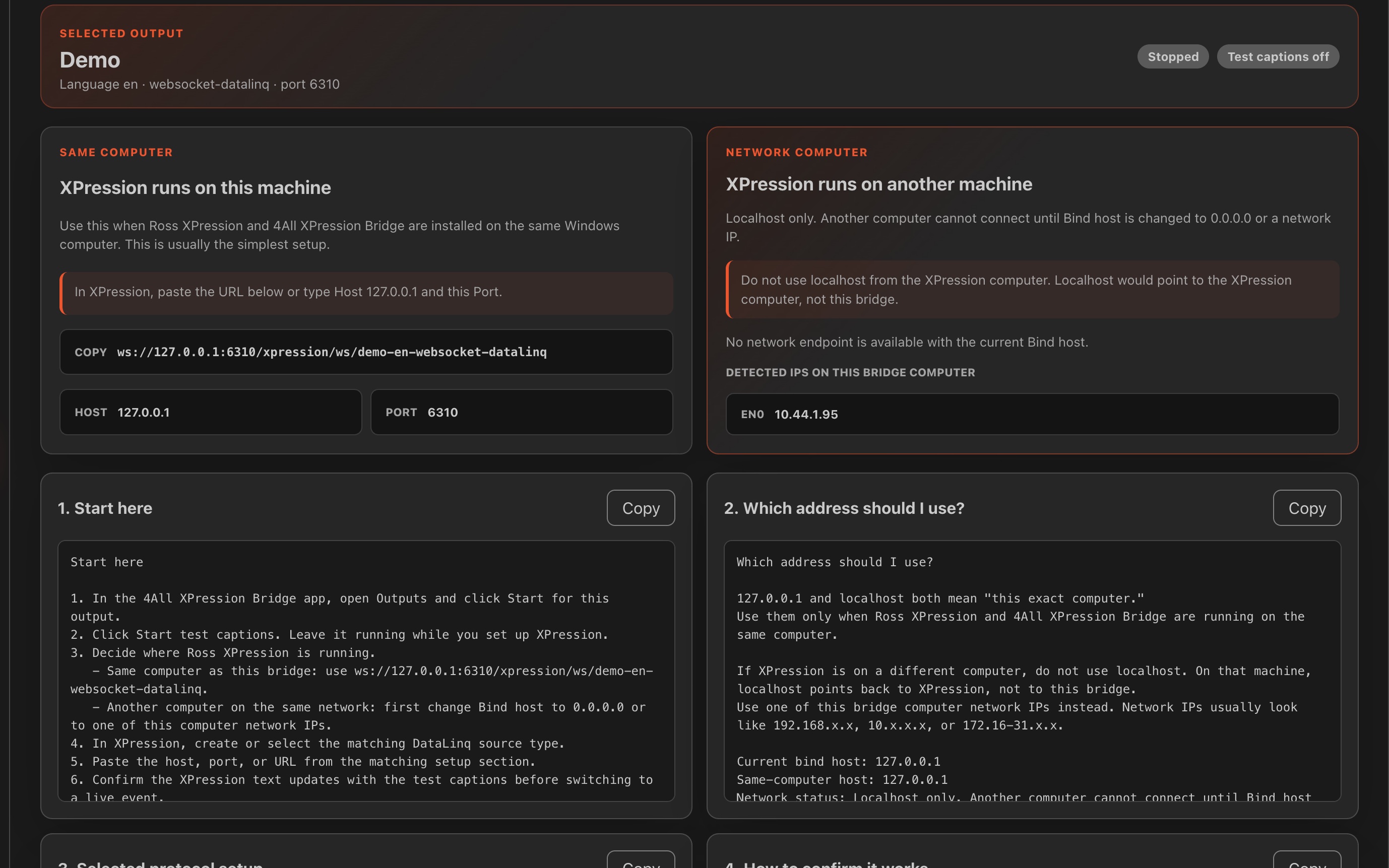
4ALL XPression BridgeA local adapter that selects a 4ALL organization, event, and language, then publishes text through documented WebSocket DataLinq, Captioning TCP client or server, RSS/HTTP, or UDP outputs. During a FIFA World Cup production at SoFi Stadium, the Bridge fed real-time 4ALL LIVE caption text into Ross XPression for the venue LED wall.
Ross CapGoA Ross/Rocket Surgery venue-captioning solution publicly described as providing AI transcription and translation to in-venue displays. Public protocol and architecture details remain limited.
AI-MediaAn upstream automatic and human caption-generation and delivery ecosystem. Generic TCP and web-service outputs are documented, but a current named XPression connector was not confirmed.
Other provider feedsRoss describes Captioning DataLinq as a receiver for third-party streams. Every provider still needs a confirmed wire format, host, port, payload, connection mode, scene binding, and monitoring plan.

Production workflow

From source audio to a verified audience output

  1. Step 01

    Choose the caption source

    Decide whether captions come from 4ALL Cloud, CapGo, AI-Media, another automatic service, a professional captioner, or a hybrid workflow.

  2. Step 02

    Confirm the receiving interface

    Obtain the exact DataLinq or network specification: protocol, client or server role, host, port, payload fields, partial and final behavior, encoding, and reconnect logic.

  3. Step 03

    Bind data into the XPression scene

    Map the incoming fields to the existing graphics design and configure line count, roll-up or instant behavior, direction, styles, and take or clear controls.

  4. Step 04

    Rehearse source to final display

    Test representative speech, languages, network failure, reconnect, graphics timing, display readability, monitoring, and the actual audience output.

Questions buyers and producers ask

Frequently asked questions

Does Ross Captioning DataLinq generate captions?

No. Ross describes Captioning DataLinq as a source that accesses streamed caption data from an upstream provider and converts or binds it into open-caption displays inside XPression. Speech recognition, translation, and caption staffing happen upstream.

Is 4ALL the only live-captioning option for XPression?

No. Ross documents third-party caption feeds and markets CapGo, while other caption providers may expose compatible data. 4ALL is one documented option with a purpose-built local Bridge and multiple published output methods.

What is the difference between 4ALL XPression Bridge and Ross CapGo?

4ALL XPression Bridge is a local adapter for captions already created in a 4ALL Cloud event; it does not recognize speech locally. Ross describes CapGo as a venue-captioning solution that performs AI transcription and translation, but its public XPression and protocol architecture is not fully documented.

Does AI-Media integrate directly with Ross XPression?

AI-Media documents caption generation and generic TCP or web-service output capabilities, but a current first-party page naming a certified direct AI-Media-to-XPression connector was not found. Treat compatibility as an engineering question until both vendors confirm the exact interface.

Which output methods does 4ALL XPression Bridge document?

4ALL documents WebSocket DataLinq, Captioning TCP server, Captioning TCP client, RSS/HTTP, and UDP outputs, with SimpleText, JSON, or XML payload options depending on the selected protocol.

Are XPression caption graphics the same as embedded CEA-608/708?

No. XPression renders visible graphics into the program or display output. Embedded CEA-608/708 is caption data carried inside a compatible video stream and decoded downstream. A production may need one or both paths.

Is 4ALL XPression Bridge certified by Ross?

No public Ross certification or endorsement was found in the reviewed sources. 4ALL documents the workflow and setup options, but the customer should validate compatibility with the installed XPression version, license, network, scene, and support plan.

How should a production choose an XPression caption feed?

Compare caption source quality and staffing, translation, protocol detail, connection mode, partial and final behavior, independent language feeds, diagnostics, support, failure recovery, pricing, and a successful end-to-end rehearsal in the actual scene.
Plan the complete audience path before show time.

Start with a free workspace or talk with 4ALL about capacity, outputs, integrations, and production support.

Start for free