Caption standards guide

CEA-608 vs. CEA-708 for live captioning

CEA-608 and CEA-708 are related caption standards used in television workflows: 608 is associated with legacy caption compatibility, while 708 is the digital television caption standard with broader service and presentation capabilities on compatible systems. In 4ALL, Encoder inserts configured CEA-608/708 data into a supported H.264 stream. The receiver and every intermediate stage must preserve and expose it.

Start for free

Last updated

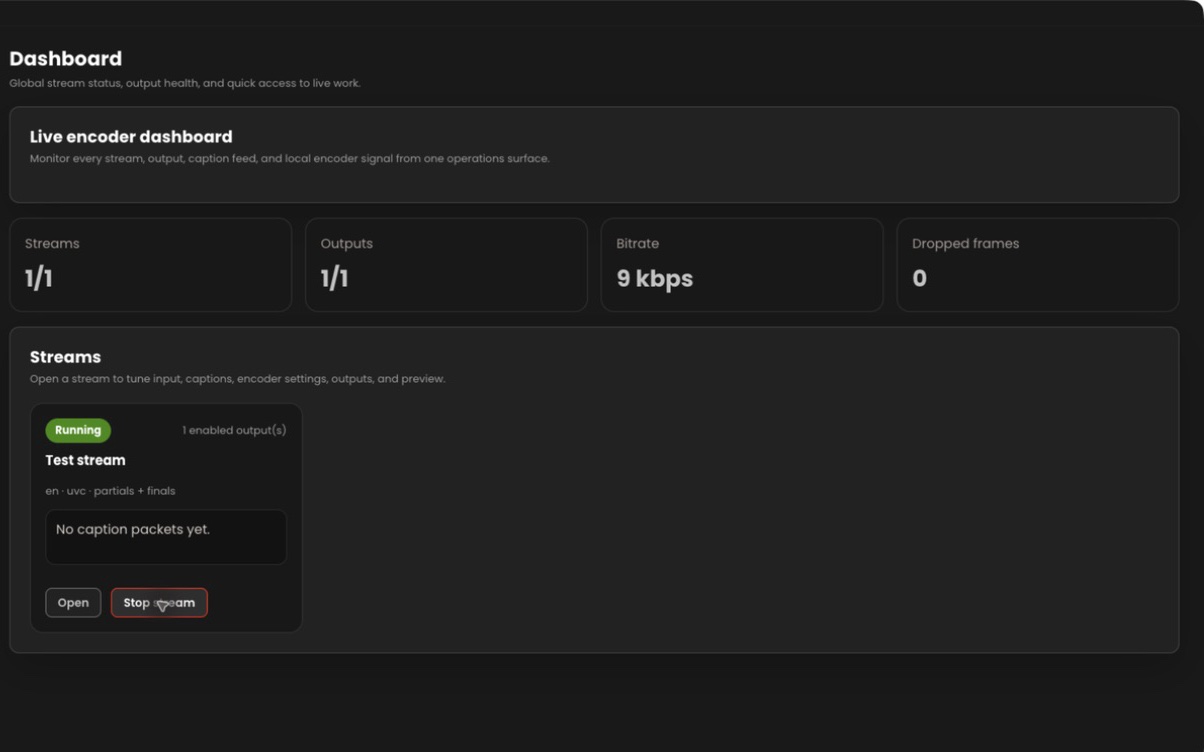
4ALL Encoder dashboard showing a running stream and caption status

What it is

A production workflow, not a one-size-fits-all promise.

The practical choice is determined by the broadcaster, destination, required services, decoder, and distribution chain—not by the encoder in isolation. A production may need compatibility across both conventions, but should configure only what the downstream specification calls for and verify the result after all relevant gateways or transcoders.

Best for

  • Producers deciding between visible overlays and embedded caption data
  • Broadcast engineers mapping a required caption service through H.264 contribution
  • Teams troubleshooting captions that exist at the source but not the decoder
  • Operators documenting a complete source-to-receiver caption preflight

Plan around

  • This planning guide does not override a broadcaster, distributor, regulator, or receiver specification.
  • Decoder presentation and service support vary across equipment and platforms.
  • The 4ALL documented embedded workflow applies to supported H.264 Encoder output.

Capabilities and outputs

What the workflow actually delivers

The exact configuration depends on the event, audience destination, enabled features, and downstream production equipment.

Capabilities for CEA-608 vs. CEA-708 for live captioning
CapabilityWhat it means in production
CEA-608A legacy-compatible caption convention still encountered in broadcast and downstream equipment requirements.
CEA-708The digital television caption standard, with service and presentation behavior that depends on compatible downstream support.
4ALL insertion point4ALL Encoder inserts the configured caption data into a supported H.264 encoded contribution stream.
Transport independenceRTMP, RTMPS, SRT, or RIST can carry the Encoder output, but the transport name does not prove caption preservation.
Verification requirementA compatible downstream decoder must expose the expected service after the real production path.

Production workflow

From source audio to a verified audience output

  1. Step 01

    Get the destination specification

    Confirm the required standard, service, language, codec, transport, and decoder behavior with the receiving organization.

  2. Step 02

    Configure the source and Encoder

    Select the correct 4ALL event language and apply the documented CEA-608/708 and H.264 settings.

  3. Step 03

    Traverse the real chain

    Send the output through the intended transport, receiver, gateway, transcoder, or platform used during the event.

  4. Step 04

    Enable and inspect the service

    Use a compatible downstream decoder to check text, language, timing, clearing, continuity, and expected presentation.

Questions buyers and producers ask

Frequently asked questions

What is the main difference between CEA-608 and CEA-708?

CEA-608 is associated with legacy caption compatibility, while CEA-708 is the digital television caption standard. Exact services and presentation depend on the downstream specification and decoder.

Does 4ALL Encoder support embedded captions?

Yes. Its documented workflow inserts configured CEA-608/708 caption data into supported H.264 encoded output.

Is an OBS overlay CEA-608 or CEA-708?

Neither. An OBS browser source renders visible web text into the picture. It does not create an embedded 608 or 708 caption service.

Can a transcoder remove embedded captions?

Yes. Any intermediate system that repackages or re-encodes the stream may alter or discard caption data, which is why testing after the final relevant stage is essential.

Should every production enable every caption service?

No. Configure the standard, service, and language required by the destination and validate that exact mapping on the receiving decoder.
Plan the complete audience path before show time.

Start with a free workspace or talk with 4ALL about capacity, outputs, integrations, and production support.

Start for free